Jumat, 16 Agustus 2019

New Motorola One Action's ultra-wide-angle camera is out to kill vertical video - Android Police

Life doesn’t stand still, and neither should you. Luckily, we’re giving you a way to capture more of what matters. Meet motorola one action, the newest device in the motorola one family that lets you capture your world on the go and see it on the big screen.

With motorola one action’s industry-first ultra wide action camera1, you can shoot video in landscape format while still holding your phone vertically.2 Your videos will be accompanied by beautiful pictures thanks to motorola one action’s triple camera system. Powered by artificial intelligence (AI) you can watch your story unfold on the breathtaking 21:9 CinemaVision display, all in an elegant design that is extremely easy to hold and use with one hand.

three cameras. endless action.
The camera meant for people on the go is finally here. motorola one action’s triple camera setup features an industry-first 117º ultra-wide action video camera1  so you can record thrilling videos that fit four times more in the frame.2

Through a unique combination of hardware and software innovation we’ve made it possible to finally film amazing ultra-wide video while holding the phone more naturally in a vertical position. And when you play it back horizontally, you can relive all your action packed memories in full screen. Enhanced Video Stabilization keeps things smooth, so shaky clips are now a thing of the past. Last but definitely not least, 2.0µm Quad Pixel technology delivers four times more light sensitivity for sharper, brighter videos in any situation.

The main 12 MP camera features phase detection autofocus (PDAF) to bring your subject into focus in the blink of an eye. While 1.25µm pixels and a f/1.8 aperture help capture more light for brighter photos. Plus, the 5 MP depth camera makes it simple to add a natural blur effect to your photo and go back and adjust intensity or the area of focus post capture for the perfect portrait shot. And included moto AI features like shot optimization, smart composition and auto smile capture4 make it easier than ever to shoot like a pro.

cinematic view in your pocket
Shoot your video then sit back and watch the action unfold. With a 6.3” CinemaVision (21:9) Full HD+ display, you can bring your shots to life on an ultra-wide cinematic display that stretches from edge to edge. Not to mention you can watch your favorite movies in their original ultrawide format on the gorgeous, cinematic screen they deserve. Plus, the 21:9 aspect ratio on motorola one action allows you to scroll less and see more while still allowing for comfortable one-handed use.

smart from the start
motorola one action comes equipped with advanced camera features powered by the deep learning capabilities of the octa-core processor. And forget about running out of space for your pictures – with 128 GB of storage on the phone, and the ability to add 512 GB with a microSD card, there’s plenty of room to keep all life’s moments.6 motorola one action also uses Universal Flash Storage (UFS), so you’ll enjoy ultra responsive performance. UFS gives you ultra fast performance and seamless multitasking capability in one powerful device.

power through your day
The 3500 mAh battery gives you a day of power on a single charge.3 You can watch 11 hours of movies as you fly across the continent — and back again — listen to your favorite playlists for 47 hours, or just take comfort knowing you have six-and-a-half days of standby time waiting for you.3

helpful innovations from Google
Whether you’re using the Google Assistant to get things done or finding your balance with Digital Wellbeing, helpful innovations from Google make it possible. Do it all while knowing your phone is running as securely and smoothly as ever thanks to Android One.5

Plus, motorola one action has the Moto Experiences you love, including Moto Actions to make everyday interactions easier by twisting your wrist to open the camera, chopping down twice to turn on the flashlight or navigating using the newly redesigned One Button Nav. Moto Display, lets you quickly preview notifications and updates to see what’s going on without unlocking your phone.

pricing and availability
motorola one action will be available starting August 16, 2019 in Brazil, Mexico and various European countries beginning at €259. It will roll out in the coming month in countries in Latin America, Europe, and Asia Pacific. motorola one action is coming to the U.S. universally unlocked and Canada in early October.

Check with your local PR rep for exact timing, availability, and pricing by market. Images can be found here (you agree to our license terms when downloading images or video).

legal disclaimers
Certain features, functionality and product specifications may be network dependent and subject to additional terms, conditions, and charges. All are subject to change without notice. MOTOROLA and the Stylized M Logo are registered trademarks of Motorola Trademark Holdings, LLC. Android and Android One area trademarks of Google LLC. All other trademarks are the property of their respective owners. ©2019 Motorola Mobility LLC. All rights reserved.

1 Dedicated 2.0μm quad pixel video camera fixed to capture 117° in a vertical position with horizontal playback.

2 Compared to the measured area of the main 78° (FOV) camera in the same aspect ratio.

3 Battery must be substantially depleted; charging rate slows as charging progresses. All battery life claims are approximate and based on the median user tested across a mixed use profile (which includes both usage and standby time) under optimal network conditions. Actual battery performance will vary and depends on many factors including signal strength, network and device settings, temperature, battery condition, and usage patterns.

4 Auto smile capture can recognize up to 5 faces/people in the same frame.

5 Android One platform in Latin America and Europe, excluding Russia. The phone initially launched in Latin America and Europe on Android 9 Pie, and will receive OS upgrades to Android Q and Android R; security updates will be provided for three years from the initial global launch date of August 2019.

6 Available user storage is less due to preloaded software, and is subject to change without notice due to software updates. Supports up to 512GB microSD card, microSD cards sold separately. Content with DRM restrictions may not be able to be moved to the card.

Let's block ads! (Why?)


https://www.androidpolice.com/2019/08/16/new-motorola-one-actions-ultra-wide-angle-camera-is-out-to-kill-vertical-video/

2019-08-16 14:54:00Z
52780354571359

Google is bringing a portrait mode to Chrome OS for some reason - Android Authority

Portrait mode on a Chrome OS tablet. Google Blog

Portrait mode has been a fixture on smartphones since Apple popularized the feature back in 2016, making its way to virtually every phone under the sun since then. Now, Google has decided to offer the feature on Chrome OS devices as well.

“Portrait mode is now available on Google Pixel Slate and we are working on bringing it to other Chromebooks,” the company noted in a blog post detailing new features in Chrome OS 76.

It’s a rather strange move, as it’s not the type of feature you’d associate with Chromebooks and Chrome OS tablets. Then again, there are people who enjoy taking photos with a tablet anyway.

Don’t expect portrait mode on all Chrome OS products, as some of these devices offer low-quality selfie cameras that might not work well with the mode, Engadget notes. Hopefully Google brings HDR+ photography to Chrome OS too, as this would undoubtedly make for a bigger improvement than portrait mode.

Editor's Pick

It’s not the first time we see portrait mode-style tech on computers though, as Skype introduced background blur during video calls earlier this year. In any event, the sheer fact that a full-blown portrait mode is now available on Chrome OS shows us just how much the tech has progressed. The mode initially required dual cameras when it first launched, but it’s now common to see single-camera portrait modes in the smartphone industry (starting with the Pixel series).

This isn’t the only new feature hitting Chrome OS this month, as Google confirmed that Chrome OS 76 also offers better media controls. More specifically, you can now open your system menu to see all apps and tabs playing audio, pausing and playing these tracks from this menu too.

Do you use the camera app on your computer or tablet? Let us know in the comments!

More posts about Chrome OS

Let's block ads! (Why?)


https://www.androidauthority.com/chrome-os-portrait-mode-1019585/

2019-08-16 07:09:33Z
52780352956616

Kamis, 15 Agustus 2019

The Google Assistant now lets you annoy your family members with assignable reminders - TechCrunch

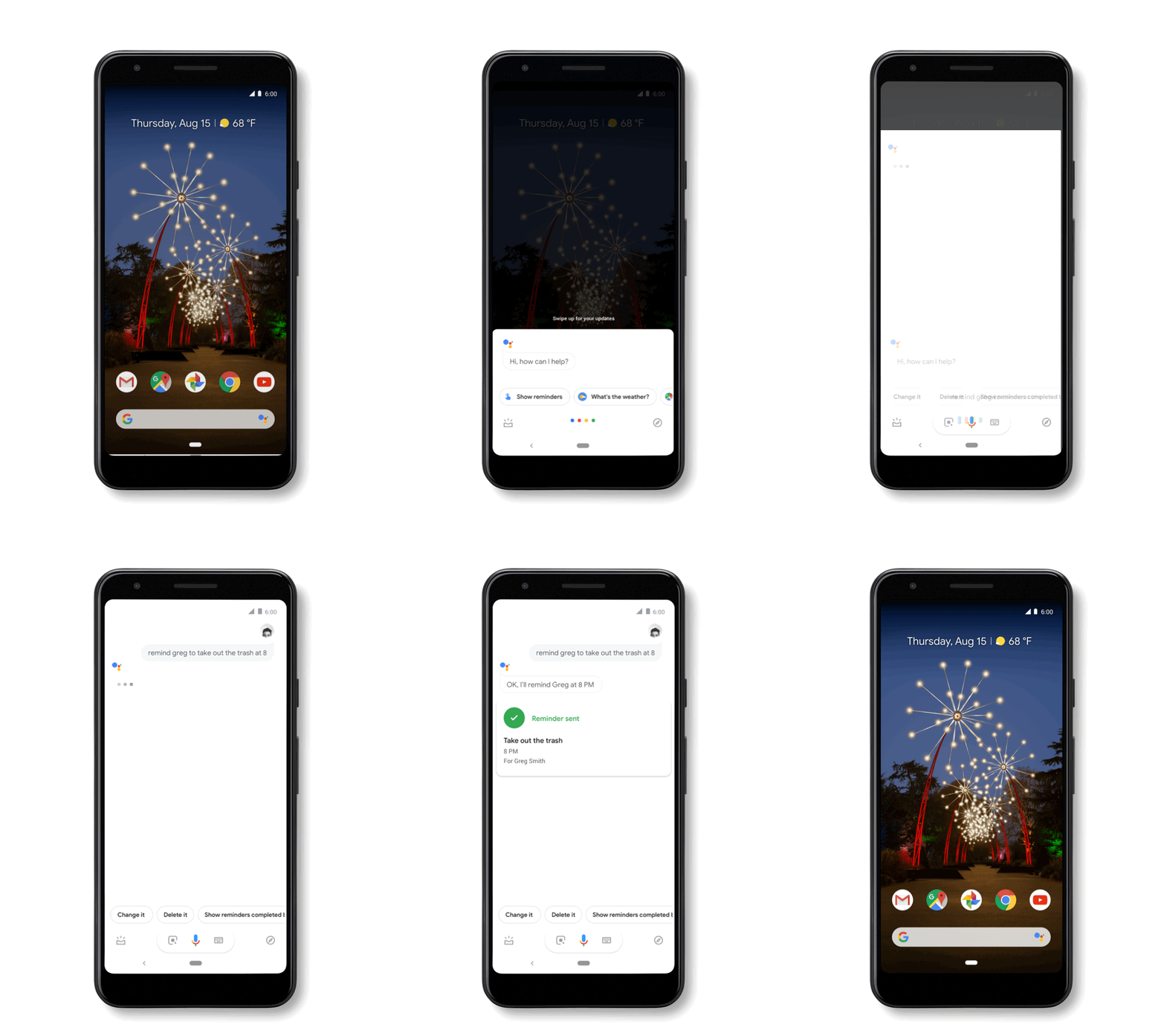
Do you sometimes have to nag your significant other to take out the trash on Monday night? Now, you can do so in a more passive-aggressive way by sending them a reminder through the Google Assistant instead of in person.

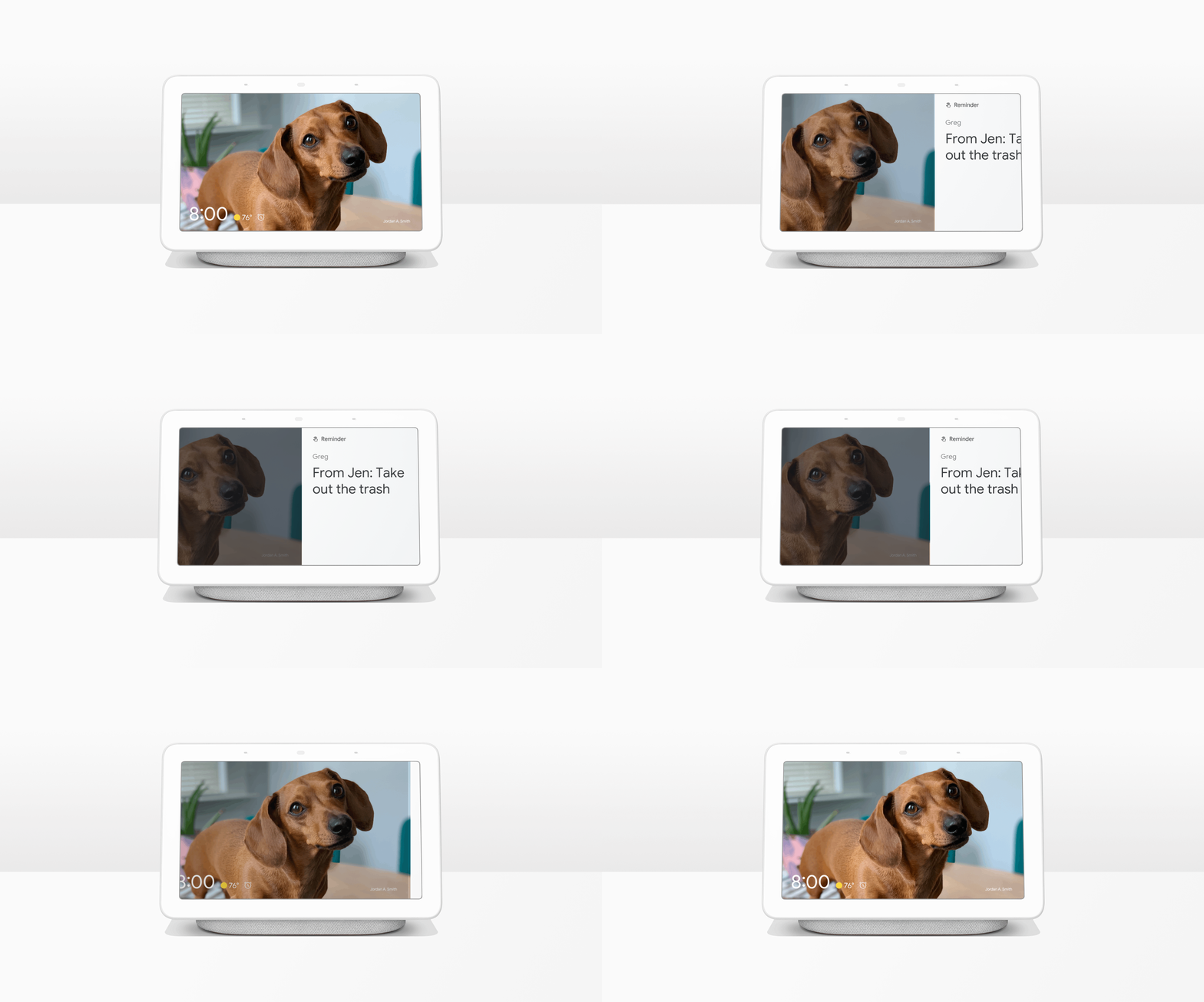
“Hey Google, remind Alex to take out the trash at 8pm,” is all it takes. Your family members (or roommates that you’ve added to your Google family group) will then get a notification on their phones and/or Assistant-powered Smart Displays.

“Assignable reminders on the Google Assistant help families and housemates better collaborate and stay organized while at home or on the go,” explains Google. “This means you can now create reminders for your partner or roommate to do things like pick up the groceries, pay a recurring bill, walk the dog — or send them a note of encouragement when they need it the most (‘Hey Google, remind Mary that she will do great on tomorrow’s exam.’)”

I’m pretty sure Mary would prefer a bit of human contact with that encouragement, but sometimes the Google Assistant is all you have.AR HubTechnically, for all of this to work, you need to have the person you are sending the reminder to in your contacts list and in your Google Family group. You also need to set up Voice Match for them for this to work on a smart display or speaker. Parents can set up accounts for children under 13 through Family Link.

This new feature will become available in English on phones, speakers and Smart Displays in the U.S., U.K. and Australia. Like with all Google reminders, you can set times and locations for your messages to pop up.

Mercifully, you can block people from sending you reminders, too, thanks to a new toggle in the Assistant Settings menu.AR Mobile

Let's block ads! (Why?)


https://techcrunch.com/2019/08/15/the-google-assistant-now-lets-you-annoy-your-family-members-with-assignable-reminders/

2019-08-15 15:18:21Z
52780353977003

TCL announces 8-series TVs, 8K, and Mini-LED - Digital Trends

Let's block ads! (Why?)


https://www.youtube.com/watch?v=ahv1g0BfaPk

2019-08-15 15:17:12Z
52780353487767

Galaxy Note 10’s ‘Link to Windows’ shortcut already ported to older Samsung phones - 9to5Google

The Galaxy Note 10 has quite a few new features, but perhaps the ones Samsung spent the most time talking about at its Unpacked event were those that came from its Microsoft collaboration. One of those features, the handy “Link to Windows” shortcut, is now available on older Samsung phones with a quick workaround. Here’s how to get it.

The best gifts for Android users

In case you missed it back on launch day, the Note 10 comes with a suite of features designed for Microsoft users. It can output content to Word, has a plethora of pre-installed Microsoft apps, and more. One of the most interesting features is a shortcut toggle in the quick settings which can be used to quickly activate a connection to your Windows PC.

This new feature is powered by Microsoft’s “Your Phone Companion” app, but it requires an additional app to enable the special features on Galaxy devices. Some users have found out (via SamMobile) that sideloading a single APK from the Galaxy Note 10 also enables the functionality on some older Galaxy devices.

To get started, you’ll need a Samsung device running on One UI. This includes the links of the Galaxy S10 family, Galaxy Note 9, and more. Technically, it should work on any device with One UI, but those are the only ones that have been tested. Next you’ll need to download the Your Phone Companion app from the Play Store and set it up. Finally, you’ll need to sideload the “Link to Windows Service” APK on your Samsung phone from a trusted source.

Once that’s done, the “Link to Windows” toggle should be available as an option in the quick settings, although you’ll need to manually add it. Tapping it may ask for permissions the first time, but after that it should quickly connect your phone to your PC.

We also can’t stress enough that you should not install this on non-Samsung phones. The results aren’t pretty.

Image Credit: Reddit u/ninjadinogaming

More on Samsung:


Check out 9to5Google on YouTube for more news:

Let's block ads! (Why?)


https://9to5google.com/2019/08/15/samsung-link-to-windows-ported/

2019-08-15 14:41:00Z
52780348894719

Smart homes are a broken mess and Nest wants to fix it - Engadget

Rishi Chandra has a vision for what a smart home should look like in five years. As the lead for Google Nest products, it's his job to think ahead. He doesn't have all the answers, he admits, but he has an idea of what he'd like to see. Given his role at one of the most influential companies in the world, his ideas about how to push the smart home forward could affect the rest of the industry. Based on what Chandra shared with me at a recent interview in New York, the future of the smart home involves a lot of playing nice, even with would-be rivals.

Chandra believes we are entering the fourth stage of computing. "We went from PC to web, web to mobile, and now we're going from mobile to ambient," he said. Ambient computing is the idea that devices like sensors, speakers and displays are embedded in the environment all around you -- thus, "ambient." Chandra also calls this distributed computing as opposed to integrated. In the latter, all the parts of the computer are in one central hub or device. Distributed computing, meanwhile, has its components scattered across a space. In Chandra's mind, these pieces fall into three categories: sensors, inputs and outputs. An input is something like a microphone in a remote or smart speaker or a touchscreen on a connected display while an output could be an Android TV, an Echo speaker or even a Philips Hue light.

There are a variety of devices that make up this ecosystem, and therein lies the problem: It's not convenient for the consumer. "There's no one thing I can put in my home and just put in the wall and be like, 'Oh, now it's all smart,'" Chandra said. Individual smart home companies sell bits and pieces of a puzzle, and to be fair, they're not wrong to focus on making the things they're good at making. Philips Hue, for example, has focused on lights, and part of its strategy has been "to ensure that partner brands work seamlessly with (its products)," according to the company's head of technology, George Yianni.

But fragmentation creates friction.

"As an industry, we're giving all the building blocks for this notion of a smart home, right? We sell you a thermostat, we sell you a camera, we sell you smart speakers, smart display, whatever it might be," Chandra said. "But then we ask the consumer to actually build the house."

Philips Hue lights

This process of building the house is made even more challenging by the fact that there are so many different standards and protocols. Each company has its own app that you need to install. Some of them connect to your WiFi, others use Bluetooth. It used to be that you had to buy a separate hub to connect different brands of products to your home network. Thankfully, the industry has wised up and we're seeing signs of improvement -- brand-specific hubs are pretty much gone.

A spokesperson for Canary told Engadget "We wouldn't say the industry right now is immensely fragmented — if anything, the industry is now more consolidated than it has ever been."

But there's still no unified platform, and it's one of the biggest hurdles to the "smart home" becoming ubiquitous.

Niccolo de Masi, chief innovation officer at Honeywell spinoff Resideo, agrees. He told Engadget, "The home is becoming more complex faster than the average homeowner can keep up with." He added that consumers are still confused, frustrated and distrustful of their smart home devices. "This is the opposite of how they're supposed to work," he said.

Not only are there too many disparate products, but also they neither communicate with each other nor do they understand context. Your devices should know what you like and where you are so they can respond to you in the appropriate place. That's not quite the case right now.

"If you have multiple Google Homes today in your house, sometimes it'll answer in the wrong place," Chandra pointed out. That's been one of my biggest complaints about the Assistant, and I vehemently agreed when he brought that up. Thankfully, Chandra is aware of the issue and said, "We're working on that."

"But that, in my mind, summarizes the problem," he added.

Chandra believes there are two key pieces that are missing. "One is a connectivity layer that actually connects all these devices to share context in a trustworthy secure way," he said. This layer might be WiFi, Bluetooth Low Energy or Thread radios, a Nest-initiated low-power network protocol.

The second missing piece, according to Chandra, is an intelligence system. "It has to be able to process: 'Oh, here's all the signals I'm understanding, here's the right output,'" he explained. So the next time you're in your kitchen and you ask your Google Home for a cookie recipe, for example, it should display the steps on the Nest Hub rather than, say, your phone.

Google Nest Hub Max

Ideally, for Chandra, the processing of these decisions would happen locally within the home, rather than relying on the Google Cloud. On-device processing is a core focus of the Face Match tool that debuted on the Nest Hub Max that Google announced in May. The smart display's camera will look out for faces of people in front of it to show personalized information and notifications. During the launch, Google stressed that the data involved in that recognition process stays on the Hub Max.

This means your data (like pictures of your face, in this case) won't be sent to the cloud for processing and the verification will happen on your device itself. This minimizes the chances for people to intercept and obtain your info. The idea doesn't just have privacy benefits either. Google's already planning to make its next-generation Assistant eventually run completely on your phone, without relying on an internet connection. "We're not stopping at the phone," Chandra said. "We want to continue to see how we can bring a lot of elements of the Assistant onto as many devices as possible to unlock this value of intelligence that sits inside the home as well."

With a powerful and secure contextual engine in place, smart home companies can focus on creating experiences that are helpful and intuitive. One of the improvements or shifts that Chandra would like to see is a switch from social personal computing -- that is, your phone existing solely to serve you -- to communal computing. That's when you have a device in your home that's meant to be used by several people who share your space.

"We have to understand the context of multiple people in the house and react to it," Chandra said. If he's listening to music by himself, for example, he wants the device to play his favorite songs. When one of his kids walks in the room, though, he wants it to be smart enough to not play anything explicit.

Google Nest Hub Max

"That's kind of the next thing we have to go build," Chandra said. And a key component is making the transitions between personal and communal seamless. But how can Google go about doing this? "We're not going to ask users to log in and out of their homes," Chandra said. He points to some Google technologies as some of those building blocks -- Voice Match on Home speakers and Face Match on the Nest Hub Max.

There also needs to be a unified platform to help reduce the friction and frustration facing consumers who buy devices from different companies. "That's where I see the biggest innovation happening," Chandra said. He recalled a time when web developers had to code four different versions of their sites for the many different browsers and rendering engines that people were using. The industry aligned then with the W3C standardized protocols for web design. Chandra believes something similar must happen for the smart home.

Other companies generally agree. Yianni said that in future, "We expect more consolidation to happen." De Masi said that the future of IoT cannot be different products with a separate app controlling each one. The good news is, it sounds like we're closer to a simple unified smart home than we've ever been.

All products recommended by Engadget are selected by our editorial team, independent of our parent company. Some of our stories include affiliate links. If you buy something through one of these links, we may earn an affiliate commission.
Comment
Comments
Share
44 Shares
Share
Tweet
Share
Save

Let's block ads! (Why?)


https://www.engadget.com/2019/08/15/google-nest-smart-home-fix-plan/

2019-08-15 12:56:58Z
52780353977003

TCL Roku TVs promise powerful images with mini-LED, QLED tech - CNET

02-tcl-8-series

Starting at $2,000 for the 65-inch version, the new TCL 8 series is the most expensive Roku TV yet.

Sarah Tew/CNET

TV nerds like myself have waited a long time for details on TCL's 2019 televisions, and now that the TV maker has finally unveiled its new sets, they don't disappoint. Two new models -- the high-end TCL 8 series with fancy mini-LED tech and an upgraded TCL 6 series that adds QLED color -- are immediate contenders for the best TVs of 2019. And of course, every new TCL TV has built-in Roku TV, my favorite smart TV system.

TCL has become one of the most popular TV brands in the US, growing by more than 60 percent in 2017 and 2018 according to market research firm NPD, trailing only Samsung and Vizio in units sold. During that time, however, its growth has mostly come from entry-level models like the 3 series and 4 series -- among my top choices for budget buyers -- but not in midrange and high-end sets.

Now playing: Watch this: TCL 8 series, 6 series boost Roku TV's picture quality...

2:34

Now the company aims to broaden its appeal to video-quality aficionados and others willing to pay more. "With the 8- and 6-Series powered by the latest QLED color technology, there are few TVs available that can match their cinematic picture quality," said Chris Larson, senior vice president of TCL.

That claim has merit. With the 2018 6 series, my Editors' Choice among LCD TVs, the company demonstrated it can nail the sweet spot between price and image quality. The new versions look even better on paper. Here's all the new 2019 TVs TCL announced today.

TCL 2019 8, 6 and 5 series TVs

Model Size (inches) Local dimming zones QLED color Price Available
75Q825 75 ~1,000 Yes $3,000 Fall
65Q825 65 ~1,000 Yes $2,000 Fall
65R625 65 120 Yes $1,000 Summer
55R625 55 100 Yes $600 Summer
65S525 65 No No TBD Summer
55S525 55 No No TBD Summer
50S525 50 No No TBD Summer
43S525 43 No No $300 Summer

TCL 8 series: 25,000 mini-LEDs can't be wrong

The 8 series shares a price ballpark with Vizio's P-Series Quantum X and Samsung's Q80R but could potentially outperform either one -- or any other high-end LCD TV. The reason? Small LEDs, and lots of 'em. TCL says the 8 series has 25,000 LEDs on the 75-inch size (and proportionally less on the 65, but representatives didn't specify exactly how many).

They're mini-LEDs, and this is the first time a TV maker has used them in a US model. Mini-LED is different from MicroLED, the display technology used by Samsung in its hella-expensive The Wall TVs, and rumored to be used in the 2020 version of the Apple Watch. MicroLED is a potentially revolutionary display tech and a candidate to replace OLED as picture-quality king, thanks to emissive technology that does away with the liquid-crystal structure of traditional LCD TVs. Mini-LED adds more, smaller LEDs to the backlight behind that structure, but otherwise the 8 series is a traditional LCD TV. I asked TCL to specify at what size a standard LED becomes a mini-LED, but representatives declined.

Thanks to mini-LED, which TCL calls "Quantum Contrast," the 8 series has around 1,000 local dimming zones, roughly twice as many as the 75-inch Vizio Quantum X (Samsung doesn't specify its number of dimming zones). Local dimming is the best way to improve LCD picture quality, and more zones generally means less stray illumination in dark objects, which leads to better contrast and overall image quality. TCL also claims superior brightness (although unlike Vizio it doesn't specify a number in nits), improved brightness uniformity, wider viewing angles and thinner design. 

In a side-by-side demo with a Samsung Q80R, the TCL 8 series indeed looked very impressive, but I'll wait until I can review one to pass judgement -- and compare the 8 series to an OLED TV like LG's C9.

TCL says that an 8K version of the 8 series will be available sometime in the future as well, and at its demo space it showed the X10, an 8K model that will ship outside the US. At CES in January it said an 8K Roku TV would ship in "late 2019."

02-tcl-series-6

The new 6 series gets QLED quantum dot tech too.

Sarah Tew/CNET

TCL 6 series: QLED could make a great TV better

If you don't want to spend two grand on a TV, yet still want a great picture, you're probably more interested in the updated 6 series. This year's version includes all of the goodness of the 2018 model, including a few more zones of full-array local dimming powered by standard-size LEDs, and adds quantum dots (also used on the 8 series).

TCL's adoption of "QLED" proves Samsung doesn't have a monopoly on that futuristic-sounding acronym -- TCL even uses the same font as Samsung. It stands for "quantum dot LED TV," and those dots are microscopic molecules that, when hit by light, emit their own, differently colored light. Quantum dots also appear in Vizio's new 2019 TVs including the M-Series Quantum. In my tests they do improve HDR color, which was a weakness of the 6 series last year.

Aside from some styling tweaks the 6 series is otherwise the same as last year. TCL didn't reveal whether there would be a cheaper Best Buy variant, and didn't announce a 75-inch size yet.

TCL 5 series: Meh

Far less exciting to me than the other two is an update of the 5 series. The only upgrades are cosmetic; TCL says the new version will have the same image quality as the 2018 model, which didn't really float my boat.  

As I mentioned at the top all of the new TCL sets use Roku's operating system. The 8 and 6 series include Roku's voice remote, while the 5 series has the standard clicker. All of the new models support Dolby Vision, and the 8 and 6 series can handle Dolby Atmos audio as well.

I'm looking forward to reviewing the new TCL TVs soon.

$1,280

CNET may get a commission from retail offers.

Vizio P-Series Quantum

Let's block ads! (Why?)


https://www.cnet.com/news/tcl-roku-tvs-promise-powerful-images-with-mini-led-qled-tech/

2019-08-15 12:00:08Z
52780353487767