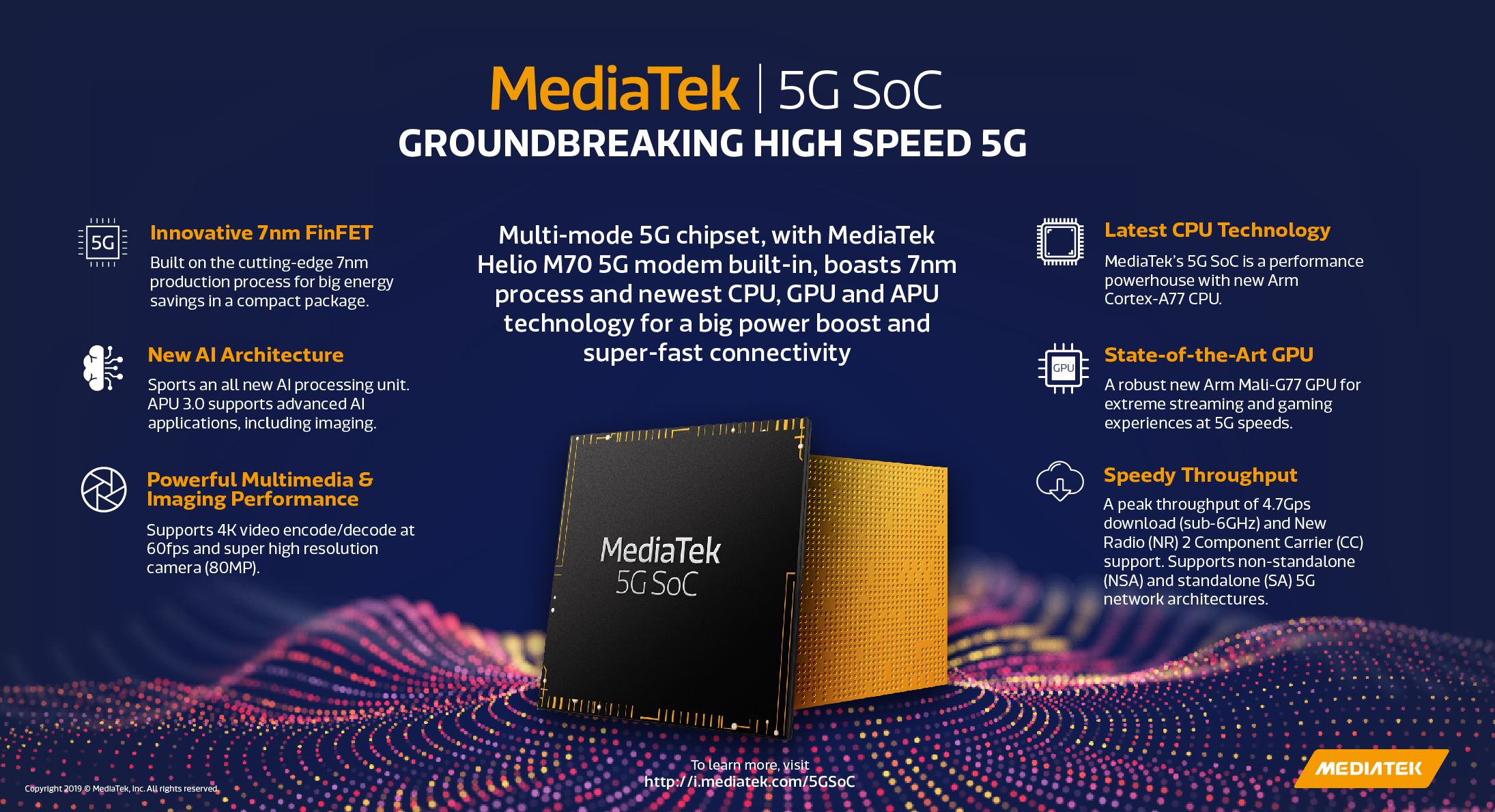
Today MedaTek is making quite an unusual announcement: The company is the first to announce a SoC with an integrated 5G modem. Even more interesting is the fact that the new silicon is the first announced design to employ Arm’s brand-new Cortex-A77 cores and new Mali-G77 GPU that were both announced only two days ago.
The odd thing about today’s announcement is that this seems like a relatively early pre-announcement. MediaTek doesn’t divulge the actual product name of the new SoC nor does it go into detail of the specifications. What is divulged however is that the chipset is built on TSMC’s new 7nm process-node, and integrates MediaTek’s own Helio M70 modem IP.
The M70 modem supports 5G NR in the sub-6GHz spectrum with up to 2x carrier aggregation. The modem supports both standalone as well as non-standalone 5G network architectures. It’s to be noted that we won’t be seeing mmWave from MediaTek this early: In the markets that the company sees the SoC we won’t be seeing mmWave networks deployed for several more years, and in general the US is the odd one out with early mmWave deployments while the rest of the world focuses on sub-6GHz coverage.
The use of Arm’s new Cortex-A77 and Mali-G77 GPU means that the SoC will have the most up-to-date IP at release, something that MediaTek hasn’t been able to achieve in a few generations. Alongside the CPU and GPU, MediaTek will employ its third generation APU design, which uses the company own in-house IP.
Finally, the imaging capabilities of the SoC are said to have been greatly enhanced and now supports 4K60 decode and encode along with 80MP ISP capability.
We don’t know a lot more about the SoC, and exactly what product category its targeting, but we expect MediaTek to still largely target the mid-range. We should be seeing devices with the new SoC released in 2020.
Intel's Open House event at Computex was filled with Project Athena devices, prototype demos, new chips and more, but the company's dual-screen prototypes were the ones that drew the crowds. Its new Honeycomb Glacier form-factor concept is for some of the most discriminating (and most PC buying-inclined) customers: gamers and creators.
ASUS might have beaten the chipmaker to the punch with its ZenBook Pro Duo -- and that's here, too -- but Intel's own design was arguably a better sales pitch for dual-screen laptops.
So let's take a look at this laptop. Yes, despite what it looks like unfolded, this is still a laptop. The prototype design has a dual-display setup made of a primary 15.6-inch screen, at full HD resolution, and a 12.3-inch display at half the vertical height. Like the ZenBook Pro Duo, the full-width companion screen is above the keyboard. However, Intel's reference design has a more considered feel, attempting to reframe the design of powerful laptops.
I was a little obsessed with those hinges and how it transforms your display location without the need for an awkward stand or secondary keyboard. From closed, the screen neatly opens up like your usual laptop. However, the primary screen then tilts upwards, at any degree you like, pulling the secondary screen along with it. It'll then stay at whatever position you pull it to, with a subtle button on the hinge for unlatching and closing. It's already surprisingly well-finished for a mere prototype.
But, and if you've read about Intel concept devices before, you might agree -- so what? Concept models and display designs often struggle to convey their reasons for existing. With this Honeycomb Glacier concept, I'd say Intel has less of a problem.
The elevated screen brings everything up to the perfect eye height -- think iMacs and other all-in-one PCs, making it a comfortable fit for activities that need a lot of attention, like video editing, writing or gaming. My mediocre efforts playing League of Legends were hampered more by the trackpad without buttons than what I was looking at. Even at a trade-show, the screen positioning seemed spot-on, and less like I was playing awkwardly on a laptop.
Even at this prototype stage, this machine could certainly handle something a little heavier. Inside there's an overclocked 45W Core i9 processor as well as an NVIDIA GTX 1070. Under the hinge, a giant circular vent pulls air across the device, with further vents dotted around the sides of the base. It means Intel can keep its processors running overclocked and tap into some secondary benefits of that elevated screen.
Look a little lower and the 12.3-inch companion screen is just that -- a companion to the main event. You could keep your Slack chat app open while you focus on tasks, monitor your gameplay stats while fighting away on LoL or monitor Twitch chatter as you stream. Because it's also propped up, unlike the ZenBook Pro Duo, it's easier to casually scan -- it's already in your field of view.
That brings me conveniently to the next marquee idea, here: relevant Tobii eye-tracking. We've covered Tobii tracking before, but unfortunately, it's either been gimmicky or simply rarely used. The hinge that acts as a seam between the two displays is perfect for the cameras and sensors, and they neatly line the center of the hinge, conveniently at eye level.
Perhaps in part due to that, Tobii's interface was working with only minor hiccups even during this early demo and amid the Intel press scrum chaos. As I shifted my focus downwards, the secondary screen automatically drew keyboard input to shrunken (but fully featured) apps. If the companies involved can make it even more reliable, then this could be perfect for instant Slack responses or replying to commenters during your YouTube livestream. You can even draw your eyes to Cortana, and it'll start listening to your requests. It's a little uncanny.
This might be the most interesting, most achievable Intel prototype I've seen in recent memory. At this formative stage, too, Intel (and whichever PC company bites at the idea: Acer, maybe ASUS?) has ample time to ensure it is ready for prime time. Some little issues need addressing: Why aren't there buttons on the unusually vertical trackpad? And the eye-tracking software really has to nail its reliability problem.
With two screens, considered design and specifications similar if not exceeding what we're playing with in Taipei, the potential for a powerful new laptop format is rather exciting. And for Intel, it might be less of a hard sell to demanding PC shoppers. The company is speaking a lot of sense -- and companies are very much interested. Following on the heels of ASUS and HP, Dell announced today that it was also working on its own dual-screen devices. M
Catch up on all the latest news from Computex 2019 here!
Intel's Open House event at Computex was filled with Project Athena devices, prototype demos, new chips and more, but the company's dual-screen prototypes were the ones that drew the crowds. Its new Honeycomb Glacier form-factor concept is for some of the most discriminating (and most PC buying-inclined) customers: gamers and creators.
ASUS might have beaten the chipmaker to the punch with its ZenBook Pro Duo -- and that's here, too -- but Intel's own design was arguably a better sales pitch for dual-screen laptops.
So let's take a look at this laptop. Yes, despite what it looks like unfolded, this is still a laptop. The prototype design has a dual-display setup made of a primary 15.6-inch screen, at full HD resolution, and a 12.3-inch display at half the vertical height. Like the ZenBook Pro Duo, the full-width companion screen is above the keyboard. However, Intel's reference design has a more considered feel, attempting to reframe the design of powerful laptops.
I was a little obsessed with those hinges and how it transforms your display location without the need for an awkward stand or secondary keyboard. From closed, the screen neatly opens up like your usual laptop. However, the primary screen then tilts upwards, at any degree you like, pulling the secondary screen along with it. It'll then stay at whatever position you pull it to, with a subtle button on the hinge for unlatching and closing. It's already surprisingly well-finished for a mere prototype.
But, and if you've read about Intel concept devices before, you might agree -- so what? Concept models and display designs often struggle to convey their reasons for existing. With this Honeycomb Glacier concept, I'd say Intel has less of a problem.
The elevated screen brings everything up to the perfect eye height -- think iMacs and other all-in-one PCs, making it a comfortable fit for activities that need a lot of attention, like video editing, writing or gaming. My mediocre efforts playing League of Legends were hampered more by the trackpad without buttons than what I was looking at. Even at a trade-show, the screen positioning seemed spot-on, and less like I was playing awkwardly on a laptop.
Even at this prototype stage, this machine could certainly handle something a little heavier. Inside there's an overclocked 45W Core i9 processor as well as an NVIDIA GTX 1070. Under the hinge, a giant circular vent pulls air across the device, with further vents dotted around the sides of the base. It means Intel can keep its processors running overclocked and tap into some secondary benefits of that elevated screen.
Look a little lower and the 12.3-inch companion screen is just that -- a companion to the main event. You could keep your Slack chat app open while you focus on tasks, monitor your gameplay stats while fighting away on LoL or monitor Twitch chatter as you stream. Because it's also propped up, unlike the ZenBook Pro Duo, it's easier to casually scan -- it's already in your field of view.
That brings me conveniently to the next marquee idea, here: relevant Tobii eye-tracking. We've covered Tobii tracking before, but unfortunately, it's either been gimmicky or simply rarely used. The hinge that acts as a seam between the two displays is perfect for the cameras and sensors, and they neatly line the center of the hinge, conveniently at eye level.
Perhaps in part due to that, Tobii's interface was working with only minor hiccups even during this early demo and amid the Intel press scrum chaos. As I shifted my focus downwards, the secondary screen automatically drew keyboard input to shrunken (but fully featured) apps. If the companies involved can make it even more reliable, then this could be perfect for instant Slack responses or replying to commenters during your YouTube livestream. You can even draw your eyes to Cortana, and it'll start listening to your requests. It's a little uncanny.
This might be the most interesting, most achievable Intel prototype I've seen in recent memory. At this formative stage, too, Intel (and whichever PC company bites at the idea: Acer, maybe ASUS?) has ample time to ensure it is ready for prime time. Some little issues need addressing: Why aren't there buttons on the unusually vertical trackpad? And the eye-tracking software really has to nail its reliability problem.
With two screens, considered design and specifications similar if not exceeding what we're playing with in Taipei, the potential for a powerful new laptop format is rather exciting. And for Intel, it might be less of a hard sell to demanding PC shoppers. The company is speaking a lot of sense -- and companies are very much interested. Following on the heels of ASUS and HP, Dell announced today that it was also working on its own dual-screen devices. M
Catch up on all the latest news from Computex 2019 here!
Apple is due to hold its annual Worldwide Developers Conference (WWDC) keynote next Monday, but we’re already getting an early look at what the company will likely announce. 9to5Mac has obtained screenshots of iOS 13, and they show the new dark mode that Apple is rumored to be including. The dark mode appears to work across the dock in apps like Music and even in the built-in screenshot tool. Apple will reportedly include a switch in the Control Center or within the main iOS Settings page.
Apple’s Reminders app for iOS 13 also appears to be getting overhauled in the company’s next operating system update. The Reminders app now has separate sections for today, scheduled, flagged, and all, and you can also search through existing reminders. Apple is also reportedly combining its Find my Friends and Find my iPhone apps into a single “Find My” app, which will likely be revealed next week at WWDC.
iOS 13 is also rumored to include a revamped Health app, updated Maps app, and even native support to use an iPad as a secondary Mac screen. Dark mode will be the most obvious visual change across the iPhone and iPad, though, and it follows months of third-party app developers creating their own dark mode skins for their apps.
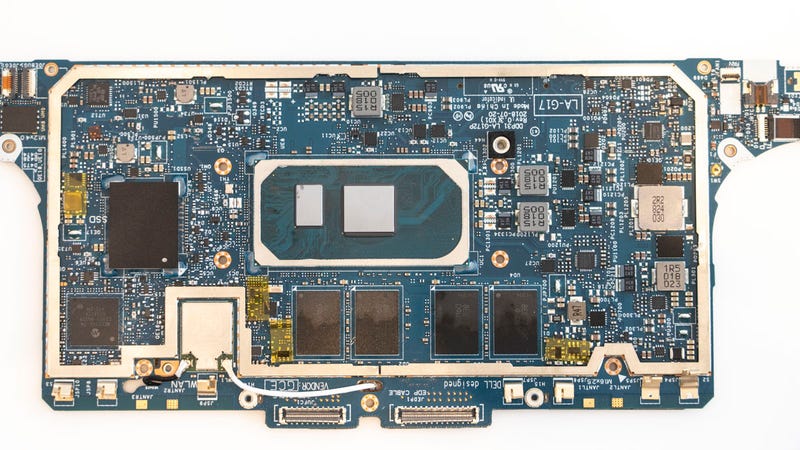
The inside of the Dell XPS 13 2-in-1. One of the first computers to feature Ice LakePhoto: Alex Cranz (Gizmodo)
In a briefing a couple of years ago, a representative for a major laptop maker sat across from me with a huge grin on his face. He had a special mock-up in his bag, and he wanted to show it off. It was a super thin Windows 10 laptop—no fans required, and maybe only 10mm thick. According to the rep, it would be one of the company’s first products supporting Ice Lake, the long in development 10nm family of chips from Intel. He assured me that at the same time the following year, he’d be showing me the real thing.
A year later, the prototype was nowhere to be found. Ice Lake, the new 10th generation of x86 chips Intel announced today, was MIA too. It will be some time before we understand just how dramatically Ice Lake’s many delays affected the laptops you and I use today (and if you know something you can securely tip us via SecureDrop or email me for my Signal number). But if you squint, you can see some good contenders for products that were supposed to be Ice Lake and got shoved out into the market without it. (Hint: Look for expensive, super thin, freshly redesigned devices sporting low-power 5-Watt Y-series CPUs.)
Advertisement
But now Ice Lake is finally just about ready for prime time, and it should make you rethink what a super thin laptop can be.
What is Ice Lake?
Ice Lake is the name 10th generation of processors based on Intel’s new Sunny Cove microarchitecture and expected to be used in nearly every 10th-Gen laptop processor made by Intel. It’s based on a 10nm technology node, which is significantly smaller than the 14nm node Intel has been using since 2014, but larger than the 7nm node used on chips by AMD, Apple, and Qualcomm. A smaller node generally means a boost in speed because information doesn’t have to travel as far. It also means better power efficiency because less power is needed to move the information.
Advertisement
Ice Lake isn’t the first 10nm part from Intel. Last year, it dropped a Cannon Lake chip, the i3-8121U based on the previous microarchitecture, Skylake. Gregory Bryant, Senior VP and General Manager of the Client Computing Group, told Gizmodo it was a “low volume production product” and made almost as a way for the company to grow more familiar with working on 10nm itself.
Sunny Cove is a whole new microarchitecture, and Ice Lake is a considerably different chip. (To the point that Intel calls it a 10nm+ part instead of a 10nm part.)
In a phone conversation, Becky Loop, an Intel Fellow and head of the Client Architecture Team said, “Ice Lake was one of the fun, cool ones and the most interesting part of it is it’s where we actually went and changed everything.”
Advertisement
What she means is this was a ground-up overhaul of the CPU. It wasn’t just moving to a new technology node. “We changed the fabric, the chassis. We touched every single IP,” she said.
And yeah, that move was challenging for the company. On the delays to Ice Lake Bryant said, “[W]e took a very challenging goal and a very aggressive scaling goal, even by our own standards, and that just proved to be more difficult, and it proved to take longer.”
What he means is it was delayed, multiple times. Ice Lake was first announced in 2014 and expected for 2016. It didn’t happen. It was, instead, delayed again and again, until late last year when Intel told press it was definitely, positively, finally coming, five years after it was originally announced, and more than three years after it should have been delivered.
Advertisement
But the company seems to think it was worth the challenges and the delay. Intel claims this is easily one of the fastest, most complex, and high performing processors it’s developed.
What’s so great about Ice Lake?
PC manufacturers have told me that that Ice Lake Y-series chips will be just as powerful as the popular U-series part found in the laptops the majority of us use, all while using less battery, and taking up less space.
Advertisement
While it isn’t announcing specific chips and the specs for the chips, Intel claims that its 10th generation chips will have graphics that two times faster (meaning even better framerate in games), wifi that is three times faster, and the ability to handle complex AI-related tasks 2.5 times faster.
Engadget attended a live demo at Computex where Intel showcased the GPU performance of a 10th-Gen U-series chip and pitted it against an 8th-Gen i7-8565U chip. Demos are carefully structured to best highlight whatever a company is trying to highlight, and in this case, it was the 10th-Gen’s GPU performance. That said, the results were impressive: It managed 70 frames per second in CSO: GO at 1080p while the 8th-Gen chip could only average 40fps.
Thunderbolt 3 is now plugged directly into the CPU, so using this port on the Dell XPS 13 2-in-1 should give you an even faster experience.Photo: Alex Cranz (Gizmodo)
Advertisement
Thunderbolt 3 and Wi-Fi 6 will both also be incorporated directly into the CPU. Loop told me that the Thunderbolt 3 connection would be particularly beneficial to people who regularly make use of external storage because it will significantly reduce latency and allow the CPU to read the files and store them in the CPU’s memory faster.
When do we get Ice Lake?
This one is tricky. Ice Lake is coming this year, but Intel has not yet announced any specific parts or when we’ll see them. Instead, you’ll have to look to Project Athena, the other news Intel is pushing at Computex this year. That suggests we could see them by late summer or early fall. Hopefully. This is Ice Lake we’re talking about. It’s been delayed before—though, a delay now that multiple products have been announced featuring the new chip would be shocking.
Advertisement
Wait, what is Project Athena?
Project Athena is a new series of specs for laptops intended to give us thin, light laptops that are super powerful but also have incredible battery life.
The hope, according to Intel’s Josh Newman, a vice president in the Client Computing Group and one of the people responsible for Project Athena, is to help improve the quality of laptops, and hopefully to reduce prices while also giving people more of the quick and seamless experience we generally associate with phones.
Advertisement
To that end, Intel has outlined general areas of laptop design where it will have exacting standards that laptop makers should meet to be considered in compliance with Project Athena.
On the size front, Project Athena laptops can’t weigh more than 3.3 pounds and can’t be thicker than 15 millimeters (though Intel says it can make some exceptions). The laptop has to connect to the internet just 2 seconds after you open it. It has to last 9 hours on a battery charge in a new typical usage test that includes browsing the web, flipping over to Word, and streaming video.
The battery was of particular focus. Sudha Ganesh, a senior director and engineer working on Project Athena, outlined some of the benchmarks Intel has developed to make our conversations about laptop battery life more honest. Currently, the battery on a laptop is tested by reviewers and laptop makers by setting the brightness of the screen to a specific level then playing back a video, either locally, or over a local streaming service. That’s not how most people use their laptop, though. We do big demanding tasks and then quick, less demanding ones. So the new test is intended to mimic the behavior of a real person by hopping between programs while leaving other programs on in the background.
Advertisement
There’s also a second test to make sure the laptop is consistent when on battery. Right now there’s a tradeoff. You can either have a powerful laptop, or you can have a laptop with great battery life. Better battery life means worse performance and vice versa.
Intel thinks it can solve this problem through components like the 10th-Gen processors. But it also thinks there’s work to be done on the software side—so computers are smarter about how they use the processor and sip the battery, and that work can be done on the design side. In much of our conversation about Project Athena, Newman referred to the laptop makers themselves and how he perceived Project Athena as something of a challenge for them to take on—A way for laptop makers to strive to make better products, not just cheaper ones.
For example, Dell announced a new 13-inch XPS 2-in-1 developed with Intel to be a Project Athena laptop. With a 10th-Gen processor and active cooling, Dell claims the new XPS is 2.5 times faster than the previous generation (with an 8th-Gen processor). Dell also claims it has 16 hours of battery life, which is nearly twice what we usually see from a 13-inch XPS.
Advertisement
But that’s just year one. Newman anticipates Project Athena will be a multi-year initiative, and with each year, laptop makers should get better and the parts hopefully more affordable. So while a Project Athena device right now might cost $1,000, future products could be $700, or even $500.
Again, this is all promise at this point. Intel promises we’ll see the payoff for these years of development soon.
Correction: We previously intimated 10nm is smaller than 7nm. It is not. We’ve corrected the piece to reflected that and regret the error.
Apple is updating the iPod touch with an A10 Fusion system-on-a-chip. Other than that, it looks pretty much like the old iPod touch with a 4-inch display, a classic home button and many different color options.
The A10 Fusion chip was first introduced with the iPhone 7. In other words, the new iPod touch performs more or less just like an iPhone 7. Just like the previous version of the iPod touch, it supports iOS 12. But you can now launch ARKit apps and start group FaceTime conversations — the A8 wasn’t powerful enough for those features.
This is a surprising move as the iPod touch hasn’t been updated since 2015. Many people believed that Apple would focus on the iPhone as there’s less demand for a smartphone without cellular capabilities. The device doesn’t support Touch ID or Face ID, so you’ll have to use a good old passcode. But it’s worth noting that there’s a headphone jack at the bottom of the device.
And yet, the iPod touch is cheap when you compare it to an iPhone. Apple is releasing three different models. For $199, you get 32GB of storage, for $299, you get 128GB of storage, and for $399, you get 256GB of storage — a 32GB iPhone 7 currently costs $449. It is available in six different colors and should be available today on Apple’s website and later this week in retail stores.
There are many potential use cases for such a device. It can be a great standalone music and video player for kids or people who don’t want to get a smartphone. You can also use it as a remote to control music on your Sonos speakers and other connected speakers.
AMD’s third generation of Ryzen CPUs are here, including the company’s first mainstream CPU to feature 12 cores, the Ryzen 9 3900X. The company is announcing five new processors as part of the lineup, all with a release date of July 7th. Their prices range from $199 to $499, and all of them are based on the company’s new 7nm Zen 2 architecture with support for the new PCIe 4.0 interface, which offers double the bandwidth of PCIe 3.0.
At the top of the lineup is the Ryzen 9 3900X. This 12 core processor has a base frequency of 3.8GHz, and is capable of boosting up to 4.6GHz. Next, the company has a pair of Ryzen 7 processors, the $399 3800X and $329 3700X. Both feature eight cores clocked at slightly different frequencies (visible in the table below) but the big difference is TDP, a basic indicator of a CPU’s power consumption. AnandTech notes that the 3700X has a TDP of just 65W compared to 105W for the 3800X, suggesting that it could be a very power-efficient processor for the amount of performance you’re getting. Finally, at the bottom of the lineup there are the Ryzen 5 3600X and 3600.
AMD Ryzen 3 CPU comparison
Model
Cores/
Threads
Base Frequency
Boost Frequency
TDP
Price
Model
Cores/
Threads
Base Frequency
Boost Frequency
TDP
Price
Ryzen 9 3900X
12C/24T
3.8GHz
4.6GHz
105W
$499
Ryzen 7 3800X
8C/16T
3.9GHz
4.5GHz
105W
$399
Ryzen 7 3700X
8C/16T
3.6GHz
4.4GHz
65W
$329
Ryzen 5 3600X
6C/12T
3.8GHz
4.4GHz
95W
$249
Ryzen 5 3600
6C/12T
3.6GHz
4.2GHz
65W
$199
AMD has a few benchmarks to show off how it expects its new CPUs to perform. The company claims that its flagship 3900X will offer similar performance to Intel’s i9-9920X despite costing around half as much ($499 compared to $1,189). Meanwhile, AMD’s benchmarks suggest that the $329 3700X beats Intel’s $374 i7-9700K in both single and multi-threaded real-time rendering performance. We’ll have to wait to try out the new CPUs for ourselves to see how their performance stacks up in general usage.
All of the new CPUs are based on AMD’s new X570 chipset, which uses the same AM4 socket as AMD’s previous Ryzen CPUs. In theory, this means that if you already use a Ryzen processor then you should be able to swap one of the new CPUs into your system without having to upgrade your motherboard. However, in practice the power requirements of the new chips will mean that not every AM4 motherboard will support them. You’re not going to be faced with a lack of choice if you do need to upgrade your motherboard for the new chips however; AMD says that there will be 56 X570 motherboards available from its partners when the new CPUs launch.
Away from its CPUs, AMD also teased its next generation of graphics cards with a demonstration of the upcoming Radeon RX 5700. This 7nm-based GPU will run on AMD’s new RDNA microarchitecture, which finally replaces the existing GCN architecture that AMD first introduced back in 2011. AMD claims that, compared to its predecessor, RDNA offers 25 percent higher performance per clock and 50 percent higher performance per watt. It will also be one of the first GPUs to support the new PCIe 4.0 interface. The new GPU is expected to launch in July.


:format(webp):no_upscale()/cdn.vox-cdn.com/uploads/chorus_asset/file/16303445/ios_13_ipad_pro_reminders_screenshot.jpg)